The space that I decided to analyze was the reading platform, Goodreads. The many times that I find myself opening Goodreads, it is a place that feels familiar, and was designed to feel that way. My impression is that it’s supposed to feel like a virtual bookshelf and library, while also functioning as a type of social media, as well. The digital shelves, algorithmic recommendations, and infinite organized lists create a network that feels unbound, but is really working through unseen boundaries of belonging. Similar to “Walking [in] the Ethnic Aisle: Latinadad/es Stocked in the Market” by Ana Roncero-Bellido, which put simply, explores how grocery stores organize cultural differences spatially, Goodreads organizes literary identity through its digital algorithms and structure.
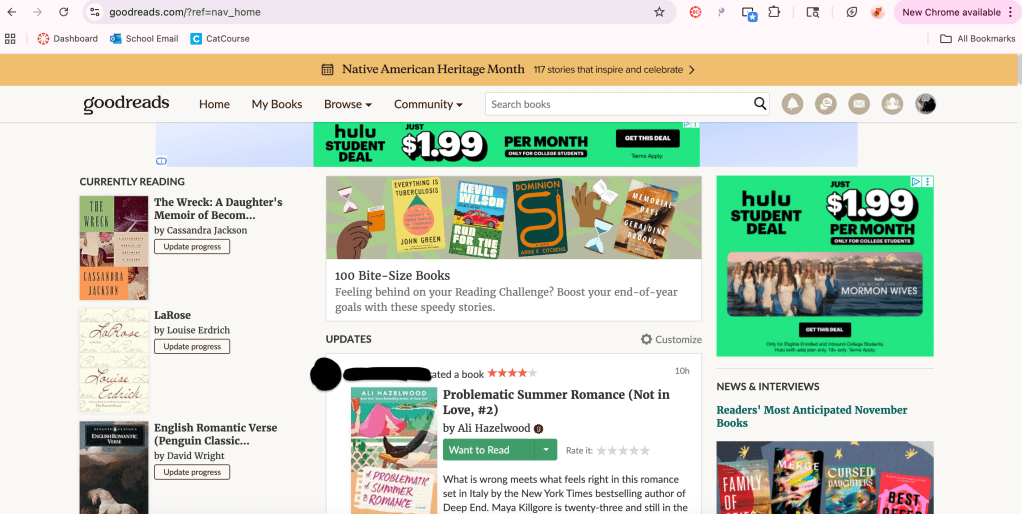
If I’m understanding correctly, I think that Roncero-Bellido is trying to assert that the ‘ethnic aisle’ of the grocery store is a contained performance of ethnic inclusivity, explaining how this aisle displays how ethnic groups are contained in a separate aisle, therefore exaggerating them as the ‘other’. Goodreads does this in a similar way; it seems as though the platform is celebrating diversity by occasionally displaying lists of LGBTQIA+ books, books in translation, and books for Native American Heritage month, but these lists are not easy to find and further separate these demographics from the ‘mainstream’ lists on Goodreads. When just scrolling through the ‘Listopia’ page on the website, the lists displayed are like “Best Books of the Decade” or “Readers Most Anticipated November Books”. The lists for the marginalized communities are often missing or hard to find. Goodreads focus on popular books and high star-ratings normalizes a literary experience that is homogenous and unchanging, pushing other identities to the margins.
After going through the ‘my books’ section, I’ve realized that even the language that’s used within the app reinforces this organizational idea of belonging; people can shelve their books in three categories, “Want to Read”, “Read”, and “Currently Reading”. This makes the platform feel more like categorizing inventory than shelving books in a library. This consistent, overarching feeling of containment, with books being something to display, store, and own is sort of encouraging a relationship to reading that is purely performative. Which I think is a sentiment all too familiar in this day and age. Roncero-Bellido writes, “Like street labels in the city, the labels heading each aisle at the grocery market—with its names and its numbers, usually on both ends of the aisle—act on clients’ bodies by directing how they ought to move across and around these spaces” (Roncero-Bellido, “Understanding the Multimodality of the Grocery”, para. 2). Goodreads uses this same strategy, guiding the readers’ digital movements through the space and how they interact with things. The different shelves and genres are used in the same type of way, letting the user know where to go and what belongs in each space.
Ultimately, I think it’s safe to say that Goodreads attempts to persuade its users through its spatial design. The website and app’s genre tabs, recommendations, and user algorithms form a mirror to society’s larger inequities; similar to grocery store aisles. Looking at Goodreads through the lens of Roncero-Bellido’s essay, the shelves and tabs become spaces that are navigating between inclusion and exclusion. Now, when I’m perusing the shelves of Goodreads, I recognize that I’m being guided through digital aisles of authority. After reading Roncero-Bellido’s essay, I’m more familiar with the ways that, even in virtual spaces, rhetoric shapes whose stories get told, and who gets to belong.
Activity #8

 Emm's Digital Library
Leave a comment